Sunday, February 5, 2012

Nguruman Escarpment Hiking Adventures

The weekend before I left to come back to the US for six weeks to wrap up my old job, I wanted one last good African adventure to tide me over through some boring DC weeks  (just kidding.  kind of.)  I went with two friends, one who really wanted to go hiking.  While trying to find something off the beaten path, we stumbled on the yet-unadvertised Sampu Lodge along the Nguruman Escarpment in southern Kenya near the Tanzania border, in the Shompole Nature Reserve.  The lodge is run by Masaai and all revenue goes into the community, one of a number of attempts in Kenya to compensate the Masaai for turning their cattle grazing land into protected wildlife reserves and integrating them into this new economy and the tourist dollars to be had (though Masaai prize cattle beyond essentially all else, and I've never particularly gotten the feeling the tourist dollar will ever trump that).  It's a complex relationship, of course, but that's the gist of it. 

One of the attractions of the lodge was that to get to it you drive past (and actually across) Lake Magadi, which we curious to see.   It's a saline, alkaline lake, fed by saline hot springs.  The water is a dense sodium carbonate brine which precipitates into a mineral called trona that forms a crust on top of the lake.  In places, the layer is 40 m thick. 


On the eastern shore of the lake, there's the Magadi Soda Factory, which produces soda ash from the trona.  Soda ash is apparently a high-demand industrial commodity used for everything from glass production to reducing acidity of chlorine in municipal pools to making German pretzels to taxidermy.  The factory is in the middle of nowhere and a rather bizarre and bleak company town has sprung up around it.


After that, it's a beautiful drive, if a little rough sometimes (and mostly definitely almost double the hour or so they had told us it would be).


The lodge itself is basic, safari tents and self-catering.  The people who run the camp are still in the early phases of learning how to manage the camp and maybe aren't getting as much support as they need.  They're friendly and trying hard, though, and the setting is unbeatable, with views over the plains and directly overlooking a watering hole.  We heard lions roaring in the bushes around the camp all night.


We went for two hikes up the escarpment, one in the evening and a longer one early the next morning.


The only bad moment in the whole weekend was that while we were roasting marshmallows around the campfire (and listening to lions roar in the bushes nearby) I dropped a glob of fiery marshmallow onto my wrist and got a hideous burn.  I like to think of the scar as a little something to remember a great trip by?

Saturday, February 4, 2012

Ceerigabo/Ceerigavo/Erigavo

Somaliland is a little tricky sometimes:  Somalia, but not Somalia at all; a humanitarian emergency but not quite.  Emergency response organizations like mine struggle sometimes to figure out the way forward.  Mine has chosen to maintain a constant presence in Somaliland, scaling up when the drought/food insecurity/famine situation worsens and scaling down when it improves.  But when the situation is better, and honestly, even when its bad, you're also exposed to the other needs in the country.  Sometimes, you also get pressure from places like the Ministry of Health to expand your activities. 

For us, in Somaliland, this means that we are aware of massive health care needs in the areas where we currently run nutrition programs and have been looking for ways to expand our programs to meet these needs.  Meanwhile, another major NGO has decided that, while Somaliland certainly has issues, it would rather focus its activities on more acute emergencies in other countries, and is discontinuing its activities in a few months.  They have been running a hospital in Ceerigabo (aka Ceerigavo or Erigavo), the capital of the eastern Somaliland region of Sanaag.  The MoH does not have the capacity to run the hospital, and this organization doesn't want the effort they have put into rehabilitating and getting the hospital fully operational after years of under use to go to waste.  Thus, they would like to potentially hand operation of the hospital over to my organization, which has a bit more of a focus on capacity building of health staff than the NGO that is currently operating the hospital.  The idea is that we would run the hospital for some period and build up the capacity of the management and clinical staff and then eventually turn the hospital to the MoH or perhaps a local organization (or see it privatized if Somaliland's new national health policy is followed...)

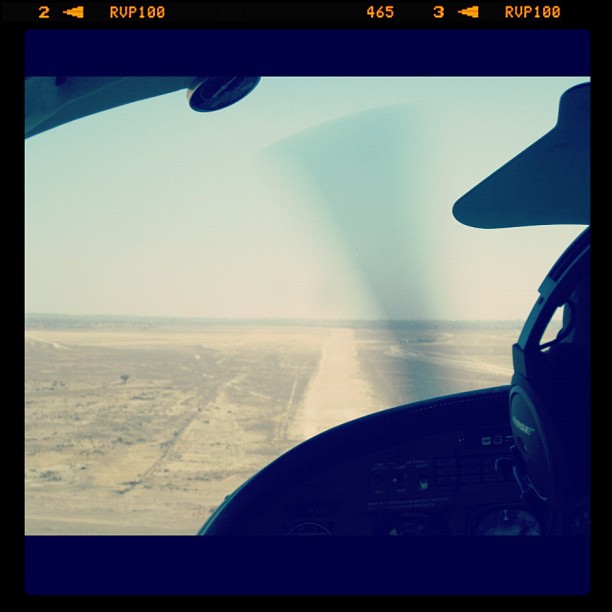
Since I'll likely write proposals to donors for funding for this project as well as start it up, the NGO invited me to fly out for a few hours today to see the hospital.  Ceerigabo is just 242 miles east of Hargeisa, but it's a two day drive and, especially for the second half, of questionable security for expats, especially when they use the road routinely.  Since I was only going for a few hours to look around, we flew. 


Let me tell you, the Ceerigabo Airport is remarkable.


 After spending hours and hours on Google Earth mapping our nutrition sites in eastern Somaliland, I felt like I was pretty familiar with the landscape, but flying over it really emphasized both how beautiful and how remote it really is.


Ceerigabo is an interesting town, one of the only multi-clan towns in Somaliland, especially in the east.  Though inter-clan violence is a fact of life in Somalia, Ceerigabo has remained relatively peaceful.  A few months ago a small wave of violence broke out, and the clan leaders came together to put a stop to it immediately.  Nonetheless, stringent security measures for NGOs working there are in place, and, like most places in Somaliland, there are remnants of the extended war.


The hospital itself is an interesting place as well, with the amazing work this NGO has done very evident--as well as the huge amount of work to be continued and some to be started as well.  I quickly found my way to my favorite unit, maternity.   As you might recall from when I worked in Somaliland last time, women don't usually seek medical care for childbirth until they have a serious problem.  It's even worse in these rural areas.  The maternity unit has a 58% complication rate (that's astronomical), and my quick tour confirmed it's a bad situation.  Let me be clear here: this has nothing to do with the quality of care they are being provided and everything to do with the state women and their babies are in before they seek medical care (or before their families allow them to seek medical care).    More than half of the 10 beds in the unit had women in them whose babies had been stillborn.  There was a 13 year old pregnant with her first child and bleeding.  Many women have 8 or 9 children already, which really increases the risk of complications.


A great moment of the day was seeing two midwives who I had worked with at Edna's hospital a year and a half ago.  They were students then and now have graduated and are employed as full midwives at this hospital.  They seem confident and competent and right at home, which is thrilling. 

And, to answer that eternal question:  what does one wear to Ceerigabo?


Friday, February 3, 2012

Nairobi National Park

I'm taking advantage of my day off to wear pants (instead of a floor length skirt, I feel like quite the rebel), read the news (I wasn't lying about that $8 Diet Coke in Luanda, which is apparently the most expensive city in the world), and catch up on a couple of blogs.

At this point, I've done most of what Nairobi has to offer in terms of tourist attractions, some of them several times (Karen Blixen House), and several I am willing to do many more times (Elephant Orphanage, gifaffes).  Nairobi National Park was one I hadn't gotten around to until a couple weekends ago.

Since it's the hot season in Nairobi right now, we left at 5 am so we would be there in the early morning cool and the animals would be active...which meant we got to see the sun come up.


We didn't see too many animals but we saw a few, mostly giraffes and buffalo.

Mostly it was just nice to be out and about in what felt like the middle of nowhere.


 But it's only just a few miles from downtown Nairobi.


Since you can only go to the elephant orphanage from 11-12 each day, we had an hour to kill.  Obviously it was time to visit the baby crocodiles at Mamba Village.  You can hold them, you just have to hold their tail really tight so it doesn't whip around and whack you and it's jaw bone closed really tight so it doesn't eat your fingers.


There's also some adult crocodiles to keep you on your toes.


They were so still they looked fake, which I may have mentioned to a staff member standing nearby.  Obviously the correct response was to poke one with a stick to prove to me they were alive. Twice.


Fortunately there were some...calmer...animals there, too.


And then the elephant orphanage.  I've been at least 5 times and it never gets old. 


Last time it was cold, and the baby elephants had blankets on (they are very susceptible to pneumonia).  This time it was hot, and the tiniest baby elephant had sunscreen on its ears.


We capped off the day with a late brunch at Talisman.  A perfect Nairobi Sunday :)

Thursday, February 2, 2012

You know what's totally awesome?

When you are standing in the middle of a street in what is essentially a subdivision on the outskirts of Hargeisa,


with a group of conservative Somali men, negotiating rent for the office/guesthouse behind you,


and a gust of wind catches both your formerly-modest, floor-length skirt and your headscarf at the same time, revealing both your very blond hair and blindingly white legs up to your knees.

 On the upside, I think we got a great deal on the lease.


Wednesday, February 1, 2012

Why I Live in and Love Africa #154

A chance to meet an African crested rat, or Lophiomys imhausi, which the New York Times recently described as "a creature so large, flamboyantly furred and thickly helmeted it hardly seems a member of the international rat consortium. Yet it is indeed a rat, a deadly dirty rat, its superspecialized pelt permeated with potent toxins harvested from trees."

I mean, how could you NOT want to encounter one of these sweet lil' fur babies and it's "twinned flank strips of doom"?


I mean, it looks so cute....


And the best news of all?? It lives in Kenya and Somalia!

On second thought, maybe I'll hold out for a sloth, which I have been rather obsessed with ever since I saw this:


And now, thanks to Ellen DeGeneres (has anyone ever said that before?), I know I'm not alone.


I'm fairly certain that's exactly what would happen to me.