Sunday, March 20, 2011

Community Health Workers, Again

I wasn’t terribly eloquent in my last posting about community health workers.  Here’s another try.

There’s nothing more valuable than a good community health worker.  For a limited investment of time (9 months give or take a few in South Sudan) and money (usually on the part of a NGO like mine), you can provide a community that previously had no health workers with someone capable of diagnosing and treating the most common diseases in that community (in South Sudan malaria and diarrhea for the most part, or pregnancy complications) and when to refer on to a higher level of care.  When this happens, it’s a beautiful model. 

When it doesn’t—and it doesn’t far more often than anyone would like to admit—community health workers are at best a drain on expenses with little to show for it and at worst a THREAT to community health instead of an asset.  They can lure organizations and communities into complacency and miss opportunities for training higher level health care workers, breed antibiotic resistance strains of diseases by misuse of antibiotics, or give a false sense of security to people who actually need higher levels of care, among other things.  If you think about CHWs usually are—rural, uneducated and as often as not illiterate or semi-literate people pulled from their communities and given tremendous responsibility with short training courses—this isn’t terribly surprising.

There’s been some pretty positive attention paid to community health workers recently, namely in a recent New York Times article about a couple of apparently very successful CHW programs in India.  Luckily, some deeply wise person at the New York Times wrote a companion article about the things you need for a CHW program to be successful.   The article talks about really important things—make the program sustainable enough so that it can last after the donor leaves!  Teach the CHWs to teach so even if the CHW doesn’t last some of their lessons will! Provide support for newly trained CHWs so they don’t feel stranded and alone!  Expand in ways that make sense for the specific setting and situation!  Get the country’s government on board!  But…

There’s always a but.  These things are HARD.  Really hard.  Of COURSE we want to do supportive supervision for the CHW, to watch how they practice and build their skills one-on-one based on each CHWs specific strengths and weaknesses. Of COURSE we want to design a program that can last long after we don’t have money from a donor anymore (emergency grants are usually 1-2 years at most).  Of COURSE we want the CHWs to teach their communities how live healthier lives.  But supportive supervision involves enough organization employees to conduct regular visits to remote and widely dispersed sites, and a security situation that allows these workers to safely go out into communities, and enough vehicles to get out to remote sites (and donors are often reluctant to fund vehicles and the fuel and insurance they take). 

This isn’t to say it can’t be done, and it isn’t to say it shouldn’t be tried.  Like I said, a good CHW is priceless.  But it is to say that I (and this is MY take on the issue) think that it is something that is being entered into too casually at the moment, without full consideration or regard for the immense complexities CHWs can entail.  

So what’s the solution?  Some it is sort of beyond the scope of my blog (does this blog have a scope?), but entail proper budgeting in the proposal where we ask the donor for money for these programs.  Another aspect involves a realistic appraisal of our limitations as an organization, and identifying and addressing these from the beginning instead of waiting until they become problems.

There’s also the “big” solution:  train enough mid-level (registered nurses and midwives) and higher-level (physicians) health workers that you no longer have to rely on CHWs.  This is the way South Sudan has recently decided to go.  But it has a long road ahead of it—curricula must be developed, schools started, qualified candidates found, and graduates placed and willing to stay in remote, rural communities across South Sudan.  Right now, there 0.5 physicians and 9 registered nurses per 100,000 people, and these are heavily concentrated in the central Equatoria region, around Juba.  And here’s a sobering thought:  even if you do all that, it’s likely that some more developed country (UK, US, Australia, in particular), itself experiencing a shortage of qualified health care workers, will snatch your newly trained health workers.  It has been estimated that as many as half the doctors in many African nations end up leaving these countries, and each time a physician leaves, it represents a net transfer of assets of approximately $600,000 from poor to wealthy country.  Those who stay are drawn to cities, not the distant areas of the country that need them the most.

Like most things in public health, this isn’t a clear cut issue.  And it’s one of the areas where my field—monitoring and evaluation—is most important.  Are CHWs actually working?  Do they decrease mortality and morbidity?  When they do, what are they doing right?  When they don’t, what’s going wrong?  Rigorous evaluation (did it work?) of CHW programs will help provide these answers, and sharing these answers among different organizations and governments will help make sure that organizations don’t keep repeating each others mistakes—and can repeat each others successes.

Friday, March 11, 2011

Up a Creek Without a Paddle

There have been some security concerns recently in the "volatile" town of Malakal, where we have several large problems.  It was mostly related to some army stuff, namely a mutiny by some South Sudanese soldiers in the integrated army as well as a clash with a rebel leader.


Malakal is not the most charming place I've ever been.  In fact, it makes Juba look like one of the lovelier places on Earth.  The power of relative comparisons.  Malakal is boiling hot (110 F).  It's insanely dusty.  It was neither foggy nor dusk in this picture.  Just dusty.


And honestly, it's just one big mess.


Anyway, Malakal.  Not so awesome.  Until....IT TURNED OUT WE GOT TO TAKE A BOAT DOWN THE NILE TO SEE SOME CLINICS AND I SAW A BABY CROCODILE!!!!


Unfortunately, there is no picture of the baby crocodile.  This is one of the great sorrows of my life to date.

There are, however, many pictures of the rest of the day.  These are the clinics, all in small villages along the east bank of the Nile.


The excitement of RIDING IN A BOAT!  ON THE NILE!


Some good things:


Went back to Juba.  There was a dog asleep in the shade underneath a helicopter on the landing strip on the way home.


The end.

Tuesday, March 1, 2011

Dispatch from Tambura Part II

As you may have gathered from my previous post, Tambura is quite rural and difficult to get around due to poor roads.  For example, see below, on our way to one of the clinics--the bridge is, uh, not functional.  As in, primarily composed of gaping, Land Rover eating holes.  And yes, yes, that IS a rosary hanging from the rearview mirror.  I believe it came in handy at several points on the trip.


Fortunately, we had a couple of excellent maps to guide our way.


The remote nature of Tambura means that, like many other places in Africa, my arrival into town does not go unnoticed.  This is partly because visitors are limited enough to start with, but the blinding white nature of my skin tips most people over the edge on the intrigue scale.  In particular, small children are regularly intrigued--and by intrigued, I mean terrified--enough of me and my abnormally pale skin that they actually burst into tears.


Occasionally my arrival sends small children scurrying off into the distance.


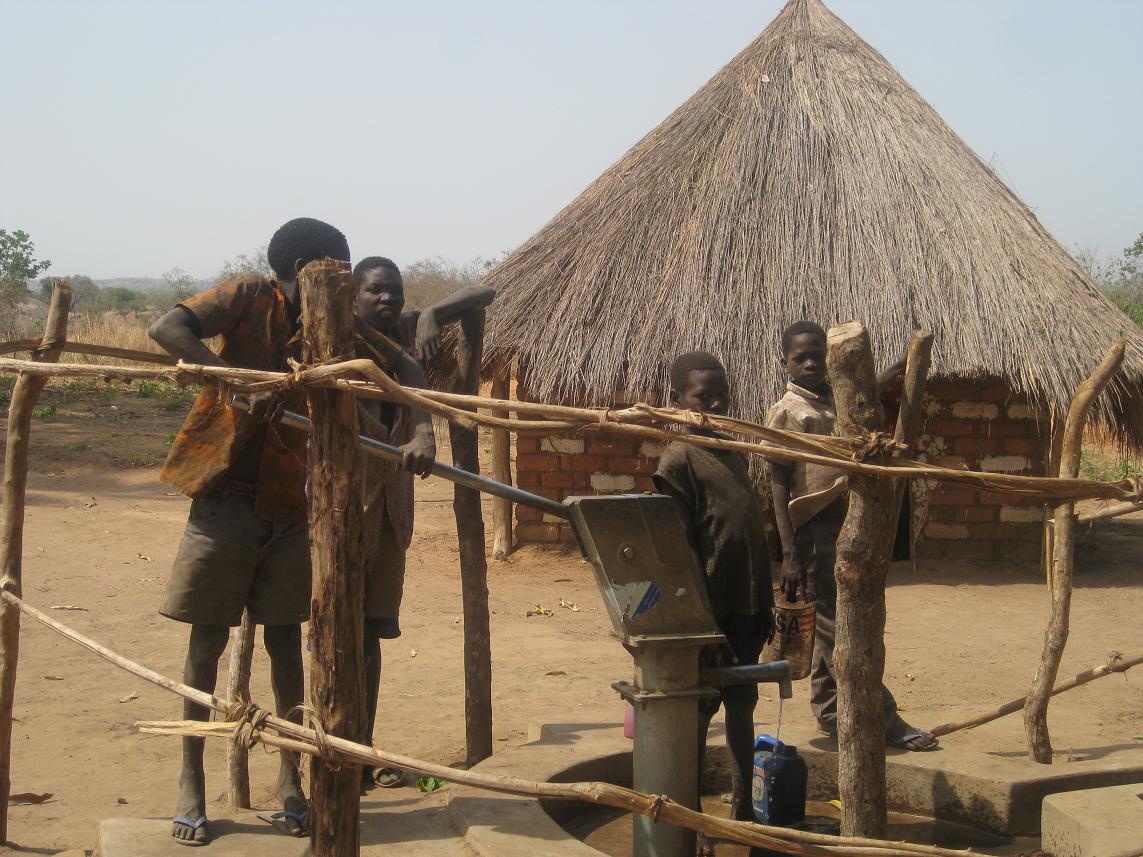
But most commonly, my arrival draw a large and attentive crowd.  Fortunately, my organization has, as part of the clinic rehabilitation we've done, put in a water point at every clinic.  This provides people with a handy excuse for immediately gathering in large numbers without actually having to acknowledge that they are there to look at me.


But it doesn't take long before the charade is totally dropped and the unrelenting staring and giggling begins.


Every country is little bit different in what happens next if a camera is involved.  In some places, as soon as you indicate you'd like to take a picture, people shake their heads or disappear.  South Sudan though...let me tell you about South Sudan.  Have you read that book "If You Give a Mouse a Cookie?"  Yeah, it's "If You Give a South Sudanese a Chance to Pose."  The South Sudanese I have met so far have universally loved the camera more than Naomi Campbell, Tyra Banks and Twiggy combined.


I always show the person the picture I've taken (the beauty of digital cameras!).  Many, especially children, have never seen a picture of themselves, and point at the screen and laugh and laugh at themselves and pull friends to look.  Then the friend wants a picture, and then the friend's friend and then...I've made a lot of friends here.

The clinic visits themselves were pretty interesting, too.  There were good things, like this beautifully managed facility. It's one of the best clinics I have seen in South Sudan.


There was the tiny tiny tiny clinic, whose village begged us to build them a new, larger facility.  I was more excited about working with them to find a solution before they flat out said that the community would contribute neither materials nor labor, even in return for food.  Oh, and the lovely new health clinic they would get at the end.  It's a pretty classic case of donors being seen as made out of money without any sense of what restrictions we have from OUR donors (hi, USAID!)  I understand where it comes from, absolutely, but sometimes it's still hard to hear people refuse to take part at all in moving forward because they believe you are there to do it for them.


We visited a clinic where they were conducting a training for a mass immunization campaign under a mango tree (good)...


And where the midwife (right) told us they had successfully resuscitated a newborn the previous week (excellent)...


And where there was the most awesome motorcycle ambulance I have ever seen (excellent).  Too bad the donor (not my organization) forgot to consider fuel (extremely difficult and expensive to get in the area) and the ambulance hasn't been used since the half tank it was filled with when it arrived finished (not good).


And where a deep and wide open medical waste pit was strewn with used needles, dirty gauze, expired pills and ampules of inject able medications.  When I pointed out that not only was I worried about a kid picking up and eating pills but actually falling into the very deep and totally unfenced pit, I was told by the clinic manager that they "tell children not to go near" and that they "know better than to fall in."  I'm sorry, have you met any two-year-olds recently? (Very bad)


Oh, and the roof.  Or lack thereof. Not a huge problem in the dry season (though the bat sqeaking in the rafters gets annoying), but in the rainy season it means there's lots of leaking.  (A problem, but in the grand scheme of things it is relatively low down my priority list.)


And then.  And then there was the clinic where I had the pleasure of teaching the sole provider of health care in the village and surrounding area, a person who has providing care to this population for many months, how to take a temperature, something he had not previously been doing because the thermometer was, "too complicated."  Since I had already borrowed a baby from the ever-present and watching crowd, I thought I might as well go ahead and have him demonstrate the rest of a child's physical exam.  At which point, I taught him how to take a heart rate, respiratory rate (which reintroduced the watch issue I faced with the midwives in Somaliland) and assess for dehydration and anemia.  This was not the moment on the trip when I felt the most positive.  When you catch something big like this, on the one hand it's really gratifying because you have a chance to correct it and probably improve the quality of care being offered.  On the other hand, it's horrifying because you wonder what else is going on out there that you've missed or haven't had the chance to see.  Turns out, nursing school IS coming in handy in this job!


Drove home in the dusty sunset.  The dust here--it's no joke.

Sunday, February 20, 2011

A Glove Compartment Full of Primate

Yes.  It's true.


I asked what it was, specifically, and he just shrugged and said, "primate" again.


I believe it may have been baboon.


We had gone to Nagero county, even more remote, further north from Tambura, to see more clinics, and the soldiers we were traveling with were thrilled to discover the women near one of the clinics we visited were selling bushmeat.  It's highly regarded taste-wise (I believe it may have been described to me as "just delicious") and a bit more difficult to find in Tambura.  It's very common in the rural areas, though, and an important source of protein.

In related news, I am now pushing a "No bushmeat in official vehicles or if you must please put it in a bag" policy for my organization.

I have to say that while the human nature part of me is fascinated, the public health part of me is absolutely horrified by bushmeat, aka "tropical wild game".  It's increasingly understood by scientists that the diseases bushmeat carries is capable of spreading disease not only to the people who hunt and butcher them but onto humans all over the world.  It is now widely believed that the AIDS virus was transmitted from chimpanzee blood that came in contact with humans when it was butchered or eaten, about a century ago.  As an awesome article in the New Yorker magazine recently put it, bushmeat's threat used to be limited to only the handful of people in isolated African villages who were exposed to viruses from bushmeat, or exposed to people who were exposed to the viruses.  But as the world has become increasingly connected, all of a sudden those diseases that once stayed put are spreading out into the world.  Last year in New York, for example, illegally imported bushmeat infected with the simian foamy virus was found.  The virus can be transmitted to humans, but the long-term effects aren't known--yet.  The concern is that another global viral pandemic like AIDS could be waiting in the wings, and the rush is on to stop that from happening. No wants ebola or monkeypox (like smallpox, though less deadly, usually).

But how do you say that to people who derive their only protein from bushmeat?  Or derive their only income from selling it?  Good ole' "risk minimization" is the favored approach right now.  Don't butcher bushmeat if you have cuts on your hands.  Don't eat primates you find dead in the forest.  But that can only get so far, and it's unclear if even these messages are permeating communities.  So for now, it's monitor carefully and wait and hope that the global public health community identifies anything before it gets out of control.

Grim, no?  If you're in the mood for a bit more grimness, I highly recommend Richard Preston's The Hot Zone, one of my favorite books of all time.

Friday, February 18, 2011

Dispatch from Tambura Part I

I haven't talked much about why I'm in Sudan, but I'll give the quick overview.  There has been a major management overhaul for a variety of reasons in the South Sudan office.  It's also a big office, with 20-22 expats at any given time and 450 national staff, running 10-11 programs worth more than $10 million dollars (this fluctuates a bit from month to month.  We have a couple of particularly large projects, three of which I am focusing on improving the monitoring and evaluation of while here--the people who gave us all that money (US Agency for International Development, the US Bureau of Population, Refugees and Migration, the European Commission Humanitarian Aid and Civil Protection, the UK Department for International Development, among others) want to know that we're achieving what we said we would and (more importantly, in my opinion) my organization wants to know how we're doing, what we can do better now and next time (this is a blog entry of its own someday). 

One of these big projects is called the Sudan Health Transformation Project (SHTP).


It's funded by USAID, in collaboration with the Government of South Sudan, through an agency called JSI Research, which in turn gave money to a number of different NGOs to implement different parts of it in different areas.  It's intended to increase access to health, water and sanitation services for women, children and families across South Sudan.  My organization is part of ensuring continued delivery and expansion of primary health care services in Tambura (red arrow) and Malakal (blue arrow).


I came to Tambura to visit some of the clinics we are working with.  We have a total of 21 clinics spread out over an area and given the state of the roads I'm obviously not going to get to all of them, but today I was able to visit 3 plus the Tambura Hospital, where we have an HIV program separate from SHTP.

Here are the three clinics.


These are all primary health care units (PHCUs), the smallest in Sudan's hierarchy of care.  They are staffed by two community health workers, a maternal/child health worker, a watchman and a cleaner.  The community health workers have had about 9 months of training on identifying and treating basic health conditions (including assisting with childbirth) and when to refer to a higher level facility.


The facilities are basic, without electricity or running water, but have most of the essential drugs and tools to identify and treat the more common health problems--malaria, diarrhea, child malnutrition (it's an infant scale hanging in the picture right below), respiratory infections, antenatal care, etc.


Because there's no electricity, vaccinations can't be stored at the clinics.  Instead, they are brought from Tambura once a month in coolers with ice packs.  It was a vaccination day at the second clinic we went to and women with their children were lined up out front waiting.


Whew, off to bed after a long day.  More tomorrow.  Until then, these two sweet faces...

This is maybe one of the cutest things I have ever seen. This kid means business with the water pump, boots and all.


And for my friends who love cats (you know who you are), I found this kitten while getting an ice-cold (well, for Africa it was ice-cold, elsewhere tepid might be a better word).  I don't like cats, but this is pretty freakin' cute.  And it didn't try to headbutt me, either.